AI service
AI Agents & Agentic Workflows
Autonomous agents that plan, call your tools and finish multi-step work — with guardrails.
Discuss your project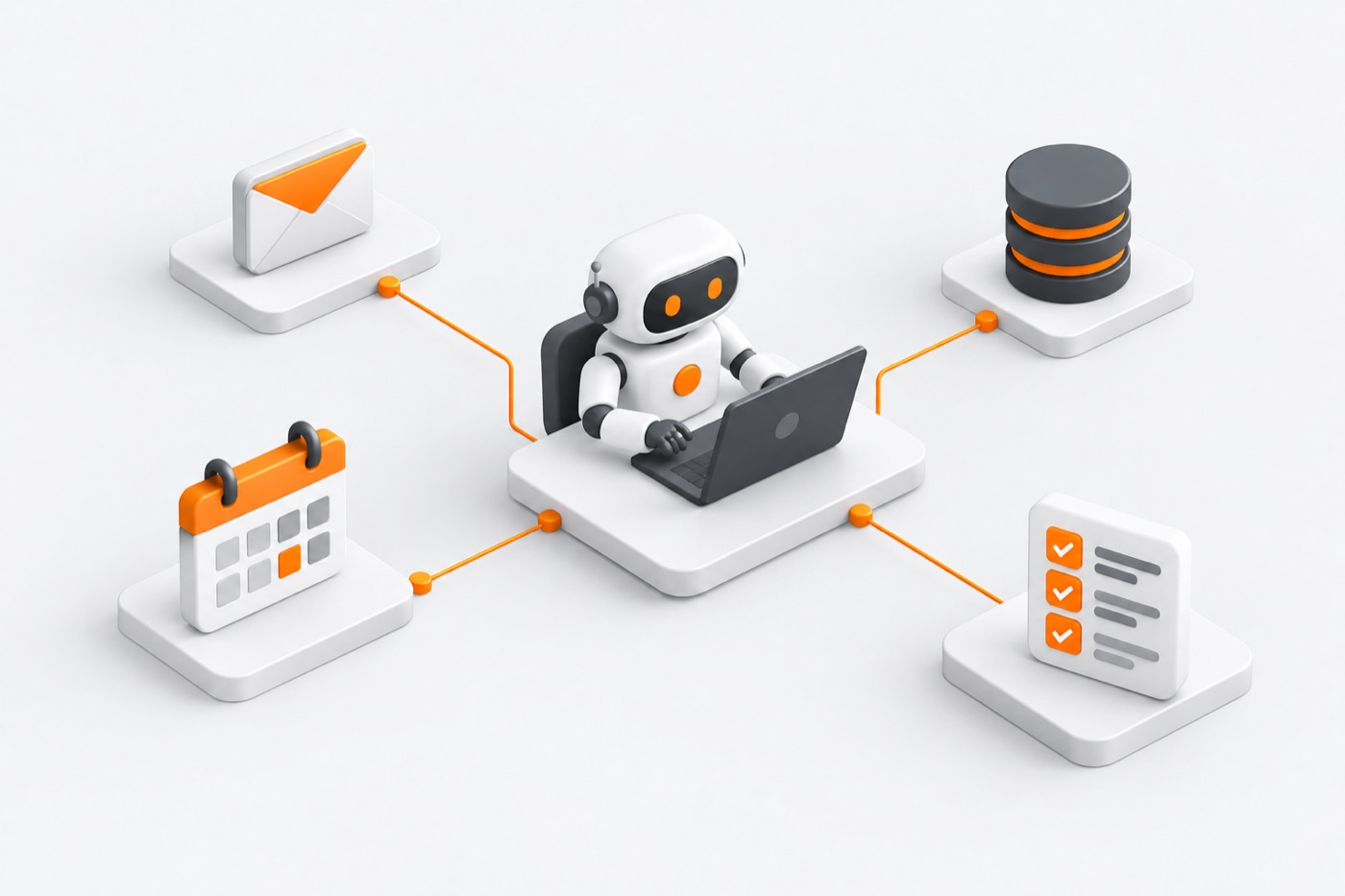
What is an AI agent?
An AI agent is software that uses a large language model to plan a task, call tools and APIs, check its own results and keep going until the job is done. Unicorn Softech designs, builds and operates AI agents that connect to your CRM, ERP, databases and internal APIs, with human approval steps, permissions and full tracing.
Inside an agent
What an AI agent is made of
PART 1 OF 7
Model
The language model that reads the task and decides the next step.
In your project: We pick it per step: a strong model for decisions, a cheaper one for routine work.
See it
What it looks like
- Plan created · 4 steps
- Tools called · 3 of 4
- Awaiting approval · 1 action
How it works
AI Agents & Agentic Workflows in 5 steps
- 01Request
- 02Plan
- 03Call tools
- 04Check result
- 05Task done
What we deliver
What you get with AI Agents & Agentic Workflows
Agent & workflow design
Task decomposition, single vs multi-agent architecture, and the right model for each step.
Tool & function calling
Typed tools over your APIs, databases and SaaS apps, including MCP servers.
Memory & state
Short-term context, long-term memory and resumable runs for long tasks.
Guardrails & approvals
Least-privilege credentials, policy checks and human-in-the-loop for risky actions.
Evaluation
Test suites that score agent runs before every release, not after an incident.
Observability
Step-level traces, cost and latency dashboards, and replay for debugging.
Common use cases
- Customer support agents that resolve tickets end to end
- Sales agents that research leads and update the CRM
- Back-office agents for invoices, reconciliation and reporting
- DevOps agents that triage alerts and run runbooks
- Research agents that read documents and write summaries
Tools and technology
We choose per project. These are the tools we use most for ai agents & agentic workflows.
- OpenAI
- Anthropic Claude
- Google Gemini
- LangGraph
- Model Context Protocol
 Python
 Node.js
 PostgreSQL
- Agent & workflow design
- Tool & function calling
- Memory & state
- Guardrails & approvals
- Evaluation
- Observability
- Customer support agents that resolve tickets end to end
- Sales agents that research leads and update the CRM
- Back-office agents for invoices, reconciliation and reporting
- DevOps agents that triage alerts and run runbooks
- Research agents that read documents and write summaries
FAQ
AI Agents & Agentic Workflows: common questions
What is the difference between a chatbot and an AI agent?
A chatbot answers questions. An AI agent takes actions: it calls tools, updates systems and completes multi-step tasks, checking its own work along the way.
How do you keep AI agents safe?
Agents run with least-privilege credentials, every tool call is validated against policy, risky actions need human approval, and every step is logged so it can be audited and replayed.
How long does it take to build an AI agent?
A focused proof of concept for one workflow typically takes a few weeks. Production rollout depends on how many systems the agent must integrate with and the approval rules you need.
Related
Related services
Let's talk about AI Agents & Agentic Workflows
Book a free 60-minute consultation. You'll leave with a feature list, a rough estimate and a practical first step — no obligation.
Book a free consultation